Dairy Asia Dialogue 2025: Dairy Cooperatives
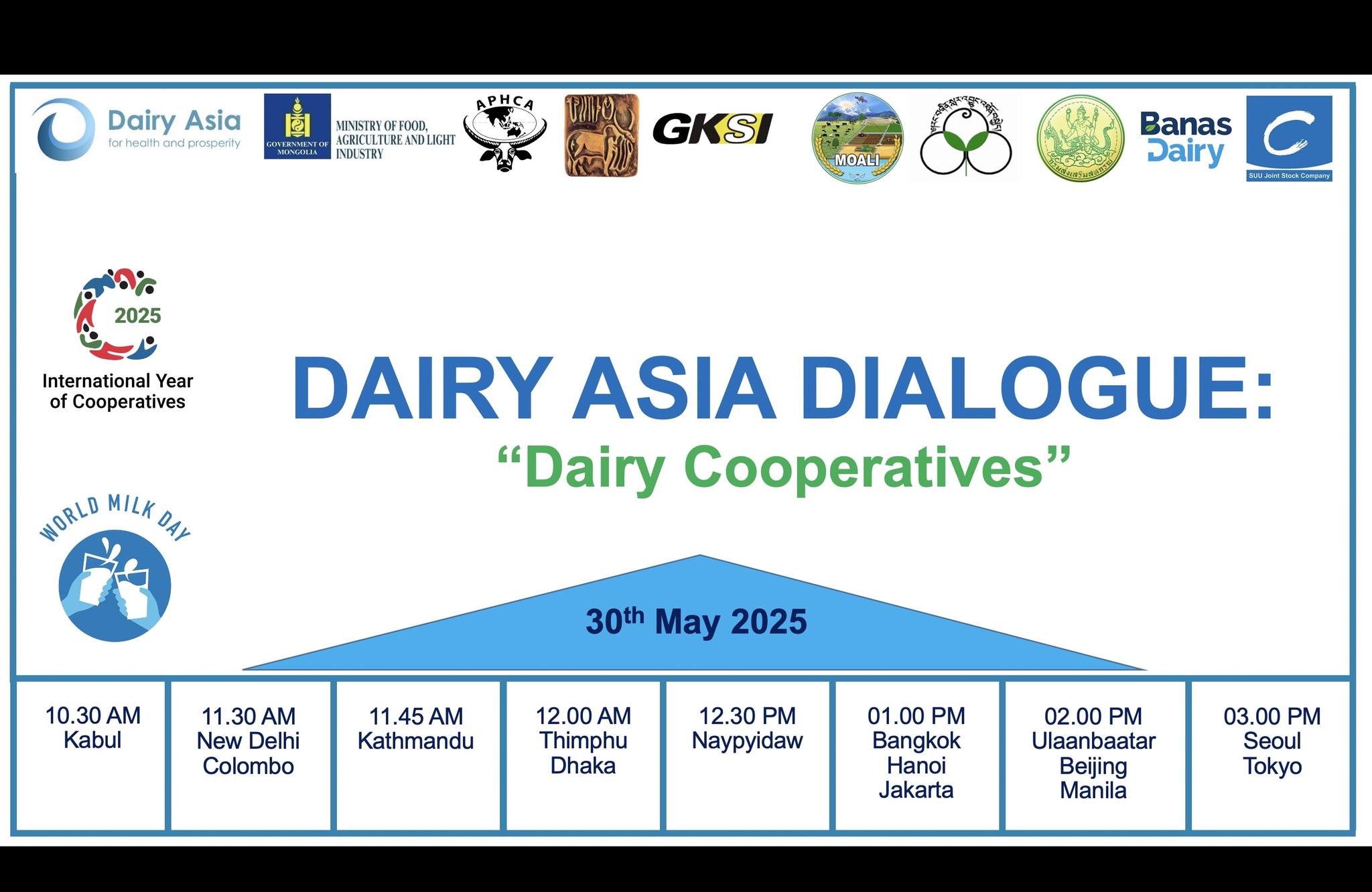
On 30 May 2025, the Dairy Asia Dialogue: Dairy Cooperatives was jointly organized by Dairy Asia, the Ministry of Food, Agriculture and Light Industry of Mongolia, the Food and Agriculture Organization (FAO), the Animal Production and Health Commission for Asia and the Pacific (APHCA), the Cooperative Promotion Department of Thailand, the Indonesian Dairy Cooperatives Association (GKSI), the National Dairy Development Board of India, Banas Dairy, the National Dairy Development Center of Bhutan, the Department of Livestock, Bhutan, the Ministry of Agriculture, Livestock and Irrigation (MoALI), Myanmar, and the SME Agency of Mongolia.
The event was held in commemoration of World Milk Day and the International Year of Cooperatives, as designated by the United Nations. The Dairy Asia dialogue commenced with speeches from Dr. T. Jambaltseren, State Secretary of the Ministry of Food, Agriculture, and Light Industry of Mongolia, and Dr. Vinod Ahuja, FAO Representative.
Dr. Jambaltseren emphasized the significance of cooperatives in Mongolia, stating: “Given Mongolia’s vast territory, harsh climate, and low population density, supporting herders and farmers through cooperatives is essential for increasing incomes, improving livelihoods, and fostering rural economic growth. The Government of Mongolia is prioritizing sustainable agricultural cooperatives by facilitating preferential loans through commercial banks.” Dr. Vinod Ahuja highlighted the critical role of dairy cooperatives in ensuring food security, enhancing nutrition, promoting sustainable livestock production, empowering women, and boosting local and regional economies.
The event brought together over 80 participants from Mongolia, India, Thailand, Bhutan, Myanmar, Indonesia, the Philippines, Nepal, Italy, Vietnam, Sri Lanka, and Kyrgyzstan. Moderated by Mr. B. Batbaatar, CEO & Coordinator of Dairy Asia, the dialogue featured presentations on dairy cooperative development across Asia:
- Development of Dairy Cooperative in Indonesia: implementing policies, best practices, and further initiatives – Keynote speaker: Dedi Setiadi, Chairman, Indonesian Dairy Cooperatives Association;
- Development of Dairy Cooperative in India: achievements, best practices and further development – Keynote speaker: Mr. Akchansh Kochar, General Manager, Banasdairy, NDDB, India;
- Development of Dairy Cooperative in Thailand: issues and options – Ms. Chunya Chongtun, Expert, the Cooperative Promotion Department, Ministry of Agriculture and Cooperatives, Thailand;
- Development of Dairy Cooperative in Bhutan – Mr. Phuntsho T Norbu, Head, Dairy Post Production Sector, National Dairy Development Center, Department of Livestock, Bhutan;
- Development of Dairy Cooperative in Myanmar – Dr. Ye Tun Win, Dairy Expert (pioneer), Member of WOAH Governance Review Committee, Former DG, Livestock Breeding and Veterinary Department, MoALI;
- Development of Cooperatives in Mongolia: policy and actions – Ms. A. Gerelzaya, Director, Policy Coordination Department, SME Agency, MOFALI;
- Best practices and facing challenges in dairy cooperatives in Mongolia: initiative from Suu JSC – Mr. B. Amarbayasgalan, Head of Project Team, Director, Milk Supply Chain Division, “SUU” JSC;
The dialogue explored achievements, policy implementation, success stories, challenges, and future strategies for dairy cooperatives in Bhutan, India, Indonesia, Mongolia, Myanmar, and Thailand.
Dairy cooperatives collectively contribute 25% to India’s agricultural GDP while supporting the livelihoods of over 80 million rural households, with women comprising 35% of stakeholders. The operational framework follows the renowned Anand Pattern, established in 1946, which implements a three-tier democratic governance structure that ensures transparency through quality-based payment systems and comprehensive farmer support programs including training and input provisions. India’s dairy dominance is reflected in its global rankings – the country leads world milk production with 239.3 million tonnes annually, while maintaining 51.33% of the global cattle population and 57% of buffaloes. This success manifests in cooperatives like AMUL, which collects 35 million liters daily, and Banas Dairy – Asia’s largest – processing 8.35 million kg daily. As the sector progresses, it focuses on critical challenges: reducing carbon and water footprints, enhancing cattle productivity through scientific interventions, developing cost-effective eco-technologies, improving soil health organically, and optimizing livestock nutrition – ensuring India maintains its dairy leadership while addressing contemporary sustainability imperatives. This unique model demonstrates how ancient cooperative principles can effectively meet modern agricultural demands on a global scale.
Thailand’s dairy cooperatives play a vital role in the national dairy industry, supported by the Cooperative Promotion Department under the 5th Cooperative Development Plan (2023-2027), which aims for 3% annual income growth for farmers through stability, innovation, and sustainability. Key policies include a market-driven approach, technological adoption, and initiatives like the Cooperative Business Potential Development Project to improve standards and management. Additionally, cooperatives benefit from long-standing programs such as the School Milk Project (since 1992) and efforts to promote local identity products. Currently, over 100 cooperatives serve over 20,000 member households, producing 2,800-3,000 tons of milk daily (~1 million tons annually) and contributing to a 7% market growth in 2023, with the industry valued at over 100 billion baht. These cooperatives provide essential services—feed supply, veterinary care, financial support—and ensure competitive milk prices (17.50-19.00 baht/kg), with many achieving international certifications (GMP, HACCP, ISO).
In Indonesia, small-scale dairy farmers play a predominant role in milk production, contributing approximately 85 percent of the national output. On average, each farmer maintains a herd of 2 to 4 dairy cows. The sector is supported by the Union of Indonesian Dairy Cooperatives (KPSI), which comprises 63 dairy cooperatives with a membership exceeding 55,000 farmers. Collectively, these cooperatives manage a dairy herd of over 214,000 cattle, with a daily milk production capacity of 1,293 tons. To enhance productivity and expand dairy farming operations, Indonesia has undertaken several strategic initiatives. These include the importation of dairy cattle from Australia to improve herd genetics and partnerships with state-owned plantation enterprises to increase land availability for dairy farming. These efforts aim to strengthen the domestic dairy industry and reduce reliance on imported milk products.
Myanmar’s dairy sector faces a significant gap between local production and domestic demand, leading to heavy reliance on imported milk products. To address these issues, the Government has prioritized boosting domestic dairy production through subsidies, quality assurance programs, and support for small-scale farmers. Dairy cooperatives play a crucial role in this strategy by empowering smallholder farmers, improving milk collection and processing, and strengthening market access. Government policies further support these efforts through agricultural cooperative promotion, livestock development initiatives, food safety regulations, and financial inclusion programs.
Bhutan’s dairy sector plays a vital role in its agricultural economy, yet faces significant challenges due to the country’s mountainous terrain and limited arable land. With only 8% of land suitable for farming, dairy production remains largely small-scale, with 78% of rural households keeping cattle primarily for subsistence. While agriculture employs nearly half the population, dairy farming struggles to meet domestic demand, forcing Bhutan to rely on imports. The Government has implemented several initiatives to strengthen the sector through the National Dairy Development Centre (NDDC). Key efforts include cross-breeding local cattle with high-yield foreign breeds like Jersey and Holstein Friesian, artificial insemination programs, and farmer training. These measures have shown progress—Bhutan now has over 220,000 cattle, with improved breeds producing 5 liters of milk per day compared to just 2 liters from local varieties. However, annual production of 43,828 metric tons still falls short of national needs.
A cornerstone of Mongolia’s cooperative strategy is the “New Cooperative Movement,” introduced to modernize traditional livestock farming practices while addressing climate challenges. Current statistics reveal a thriving cooperative ecosystem, with 11,631 registered cooperatives engaging 304,730 active members nationwide. Agricultural cooperatives dominate the landscape, comprising 51% of all cooperatives. The government has backed this growth with substantial financial support, allocating approximately $113.7 million in cooperative loans and $83.7 million in loan guarantees in 2024.
Common challenges in dairy cooperatives in the region include animal health risks, climate change, land scarcity, low productivity, farm infrastructure, limited value addition, and supply chain inefficiencies.