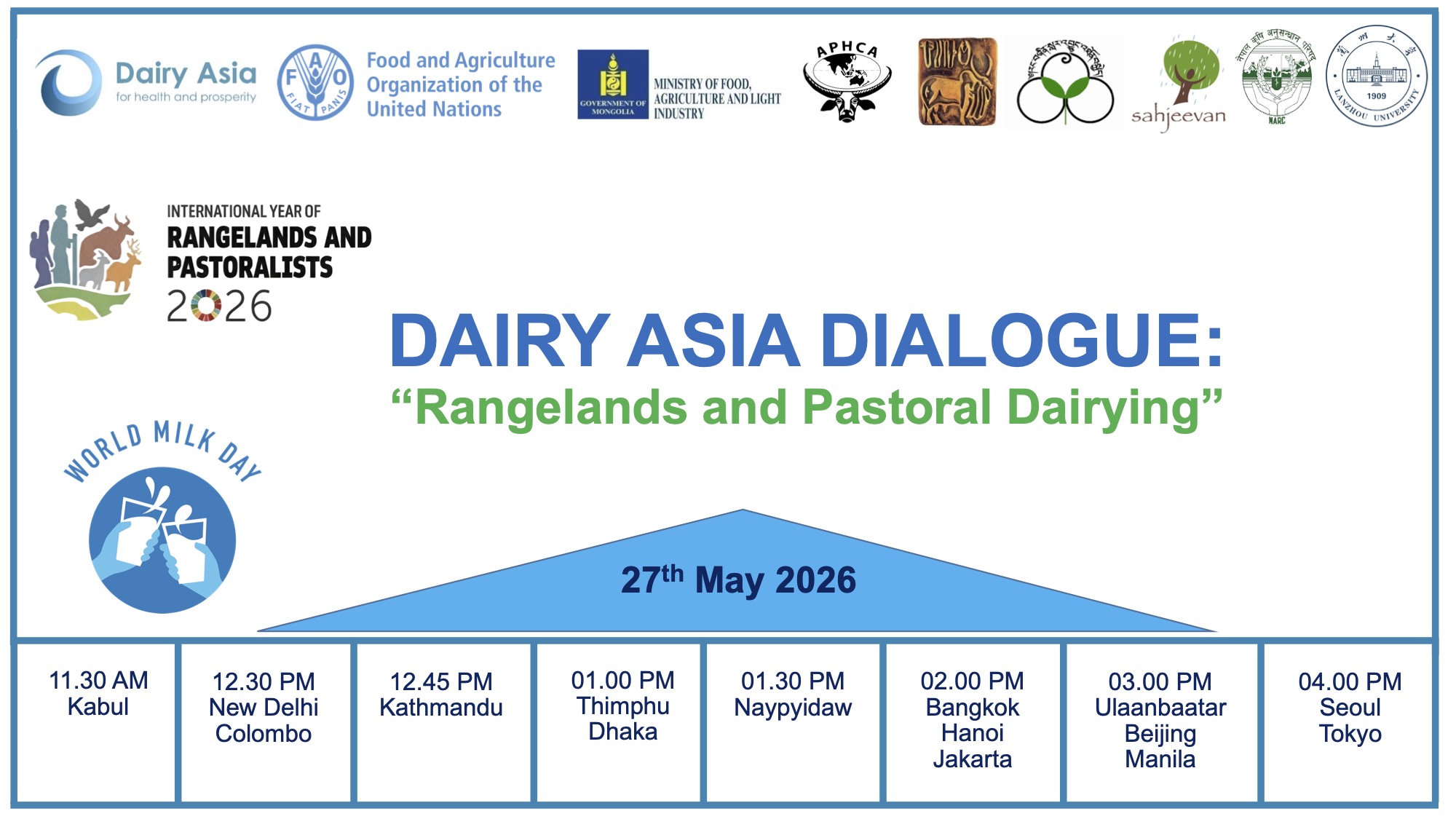
On 27 May 2026, the Dairy Asia Dialogue: Rangelands and Pastoral Dairying was jointly organized by Dairy Asia, the Ministry of Food, Agriculture and Light Industry of Mongolia, the Food and Agriculture Organization (FAO), the Animal Production and Health Commission for Asia and the Pacific (APHCA), Global Agenda for Sustainable Livestock (GASL), the National Dairy Development Board of India, Sahjeevan, the Department of Livestock, Bhutan, Nepal Agricultural Research Council, International Centre for Tibetan Plateau Ecosystem Management, Lanzhou University, China.
The event was held in commemoration of World Milk Day and the International Year of Rangelands and Pastoralists, as designated by the United Nations. The Dairy Asia dialogue commenced with message from Dr. Chingyun Diao, FAO Representative, and she highlighted the role of rangelands and livestock in ensuring food security, enhancing nutrition, promoting sustainable livestock production, and supporting local and regional economies.
The event brought together over 70 participants from Mongolia, India, Nepal, Bhutan, China, Indonesia, Kazakhstan, Kyrgyzstan, Japan, Thailand, and Sri Lanka.
Moderated by Mr. B. Batbaatar, CEO & Coordinator of Dairy Asia, the dialogue featured presentations on dairy cooperative development across Asia:
India has between 10 to 12 million pastoralists who manage 30 percent of the country’s livestock and 44 percent of its indigenous breeds, contributing 1.3 lakh crore rupees annually to the economy. They manage 10 percent of India’s drylands and high-altitude ecosystems, covering over 319,000 square kilometers of rangelands, which are critical for biodiversity, endangered species, and carbon sequestration.
However, pastoralists face several policy challenges. Four decades of reversible policy choices have led to restricted grazing access, lack of investment in veterinary infrastructure and cold chains, inefficient markets hurt by wool imports and synthetic subsidies, and inadequate policies that kept pastoralists invisible in censuses for 105 years. Grasslands have been degraded by tree plantations and green energy projects, which are scientifically unsound as carbon solutions, as well as by invasive plant species.
Sahjeevan has done substantial work to support pastoralists. It has helped establish five breeders’ associations and get 11 indigenous breeds registered with NBAGR. On grazing rights, Sahjeevan filed 312 claims covering over 302,000 hectares, resulting in 77 titles issued and 100 community forest management committees formed. For non-bovine milk, the Amul Camel Milk Dairy now has an annual turnover of 10 crore rupees, helping pastoralists earn between 25,000 and 30,000 rupees per month. For wool, Sahjeevan has created over 25 brands and established supply chains and processing facilities in three states. In grassland restoration, 47 community committees have restored 30 square kilometers, and four committees have leveraged carbon markets. On policy, after 105 years, the 21st Livestock Census of 2025 has recognized pastoralists as a distinct production system, and three states—Himachal Pradesh, Maharashtra, and Karnataka—have adopted pro-pastoralist policies.
In the Banni grassland, Asia’s largest tropical grassland spanning 2,500 square kilometers and home to 8,000 households and 100,000 livestock, 50 percent of the area has been invaded by the invasive species Neltuma juliflora. Community-led committees have restored 40 square kilometers by removing the invasive plant. A biochar-based carbon pilot restored about 1,100 hectares, produced 700 metric tons of biochar, sequestered roughly 1,600 tons of carbon dioxide equivalent, created livelihoods for over 75 households, increased forage availability, and led to 12 times greater species richness and 28 to 64 percent higher biomass productivity.
Additionally, pastoral milk is organic, low in fat, easy to digest for lactose-intolerant people, and rich in nutrition. Sahjeevan has also trained pastoral youth to set up community enterprises that make artisanal cheese from goat and sheep milk. A traveling exhibition called “Living Lightly” showcases pastoral ways of life to bring stakeholders together for policy change.
China’s rangelands cover nearly 40 percent of the country’s land area, mainly in Inner Mongolia, Xinjiang, Tibet, and Qinghai, and they serve as ecologically fragile national barriers for water conservation, carbon storage, and biodiversity. The Hu Line, also known as the Heihe-Tengchong Line, divides China such that the west holds 56.2 percent of the land but only 5.9 percent of the population and 12 percent of GDP, while the east holds 43.8 percent of the land with 94.1 percent of the population and 88 percent of GDP.
Pastoralists in China raise cattle, yaks, sheep, goats, and camels using seasonal movement, with small, mixed herds that produce low milk yields but high quality for local use. China has approximately 95 percent of the world’s 17 million yaks, and its annual yak milk production exceeds 800,000 tons, with commercial purchase volume reaching nearly 120,000 tons. Yak milk contains CLA and A2 beta casein, making it a high-quality product referred to as the “cream of the crop” among dairy products. The Hualing Dairy Group has developed over 100 kinds of yak milk products using a cooperative model that includes companies, technology, production bases, and farmers.
China has between 300,000 and 400,000 Bactrian camels, producing an estimated 30,000 to 50,000 metric tons of camel milk annually, with a market value of approximately 0.5 to 1.0 billion RMB. Camel milk sells for five to ten times the price of cow milk because it is naturally low in lactose, rich in insulin-like proteins and immunoglobulins, high in vitamin C and iron, and hypoallergenic. China also has an estimated 20 to 25 million dairy goats, producing about 3.0 to 3.5 million metric tons of goat milk annually, making China one of the world’s largest goat milk producers alongside India, Bangladesh, and Sudan.
However, pastoral dairying in China faces serious challenges, including overgrazing, land degradation, and climate variability. Today, many pastoral dairy farmers face a survival crisis because feed costs have risen sharply while milk prices have dropped due to oversupply, and young herders are moving to cities, causing labor shortages. In 2024, China’s raw milk production fell for the first time in decades, and many small and medium farms are losing money and carrying debt.
The Chinese government has stepped in with short-term fixes such as loan forbearance, subsidized domestic forage, school milk programs, consumption vouchers, and buying up excess milk to prevent culling of cows. Since the 2000s, China has also invested heavily in industrial dairy farming, shifting from rangelands to confined, feedlot-based dairying with large-scale “10,000-cow” ranches, automation, and integration with crop production. This shift has boosted milk yield and food safety but has disconnected dairying from rangelands.
According to Professor Long, the future is not about choosing between industrial versus traditional systems but about matching systems to landscapes. In productive areas, intensification makes sense, but in fragile rangelands, low-intensity, high-value pastoral dairy is the better path. Future solutions include rotational grazing, payment for ecosystem services, value-added products like local cheese and yogurt, and climate adaptation measures such as drought-resistant forages and early warning systems.
Professor Long proposes a four-bio-components model of the pastoral ecosystem consisting of plants, animals, microbes, and humans as managers, as well as a three-function model that balances ecological function, production function, and livelihood function. The goal is functional integrity, which means balancing ecology, economy, and society. The presentation concludes that China’s pastoral dairy sector is at a crossroads, and real resilience requires protecting rangelands as living systems, not just feed factories.
Bhutan’s rangelands, known as Tsamdro, span diverse ecosystems from subtropical grasslands to alpine meadows. Before nationalization in 2007, 1.3 million acres supported 5,500 households. Today, these rangelands sustain 35,000 yaks, 25,000 cattle, and 5,000 horses, providing livelihoods for over 1,300 highland and lowland households.
The Land Act of 2007 nationalized rangelands, replacing traditional slash-and-burn with prescribed burning under management plans. Best practices include mobile app mapping, corral fencing, and traditional governance using carrying capacity assessments. Achievements include mapping 400,000 acres of highland rangeland and issuing legal ownership rights.
Major challenges include rangeland degradation, loss of winter grazing areas to development, and climate change impacts.
Bhutan has two pastoral systems: the transhumance agropastoral system (25,000 local cattle) and the yak production system (35,000 yaks), contributing 3–5% of national milk production. Achievements include yak cooperatives, a national yak federation, artificial insemination trials, and high-value products like yak fiber and cheese.
Threats to pastoral livelihoods include low productivity, youth out-migration, climate change, disease outbreaks, and human-wildlife conflicts. Future actions focus on rangeland restoration, breeding interventions, high-value product development, strengthening institutions and health services, and exploring carbon financing.
The core message is that pastoralists are custodians of rangelands, biodiversity, culture, and water resources. Saving pastoral systems means saving culture, landscapes, ecosystems, and mountain livelihoods.
Nepal has 29.16 million people, with 57% engaged in agriculture and livestock contributing 24% to agricultural GDP. Rangelands cover 12% of Nepal’s land and are rich in medicinal plants, but most are deteriorated due to overgrazing, leading to low productivity and uneconomical livestock rearing. Thirty percent of rangelands lie within national parks and wildlife reserves. Sixty-four percent of mountain rangelands are used by migratory herds, including 2.6 million cattle, 0.7 million yaks and chauris, and 4.5 million goats. Yaks are protected under the 1973 Wildlife Conservation Act.
Key policies include the National Rangeland Policy (2012), Pastureland Nationalization Act (1974), and Dairy Development Policy (2021). However, the rangeland policy needs revision to align with Nepal’s new federal structure.
In milk marketing, the government collects 20% while private dairies handle 80%. Best practices include community co-management, rotational grazing, indigenous knowledge, prescribed burning, and livelihood diversification.
Major challenges and future actions focus on governance and grazing rights, rangeland restoration, research and monitoring, and capacity building through veterinary services and training for pastoral communities.
In 2025, Mongolia’s national livestock population includes 4.7 million cattle, 32.8 million sheep, 28.6 million goats, 5.2 million horses, and 0.6 million camels. The government has implemented raw milk producer incentive programs to support dairying in cold seasons.
Globally, rangelands cover 54 percent of the Earth’s terrestrial surface, with over 500 million pastoralists worldwide. Mongolia’s pastureland covers 112 million hectares in 2025, which accounts for 0.7 percent of the global terrestrial surface and 1.4 percent of global rangelands.
Mongolia plays a leading role in the IYRP 2026 initiative. Mongolia serves as the Chair of the IYRP Steering Committee, with Uruguay as Vice-Chair and FAO as Secretary. Government representatives include South Africa, Kenya, Mongolia, Sri Lanka, Spain, Ireland, Uruguay, Canada, Jordan, Australia, and New Zealand. Non-governmental members include ICARDA, UNCCD, World Bank, World Reindeer Herders’ Association, World Alliance of Indigenous and Nomadic Peoples, International Land Alliance, WWF, and the International Meat Secretariat.
The action plan has four strategies. Strategy 1 focuses on coalition building to create a global partnership. Strategy 2 focuses on knowledge generation, documenting local knowledge and best practices. Strategy 3 focuses on policy advocacy to support rangelands and pastoralism over the next decade. Strategy 4 focuses on appropriate investment, correcting past inappropriate investments such as forced sedentarisation, introduction of invasive species, privatization of resources, and badly planned water point development.
Dr. Munkhnasan highlighted that The Global Pastoralist Gathering and Conference will take place in Mongolia from 10 to 15 August 2026, bringing together pastoralist representatives and organizations from around the world.

© 2026. Dairy Asia. All rights reserved. Developed by Mind Agency