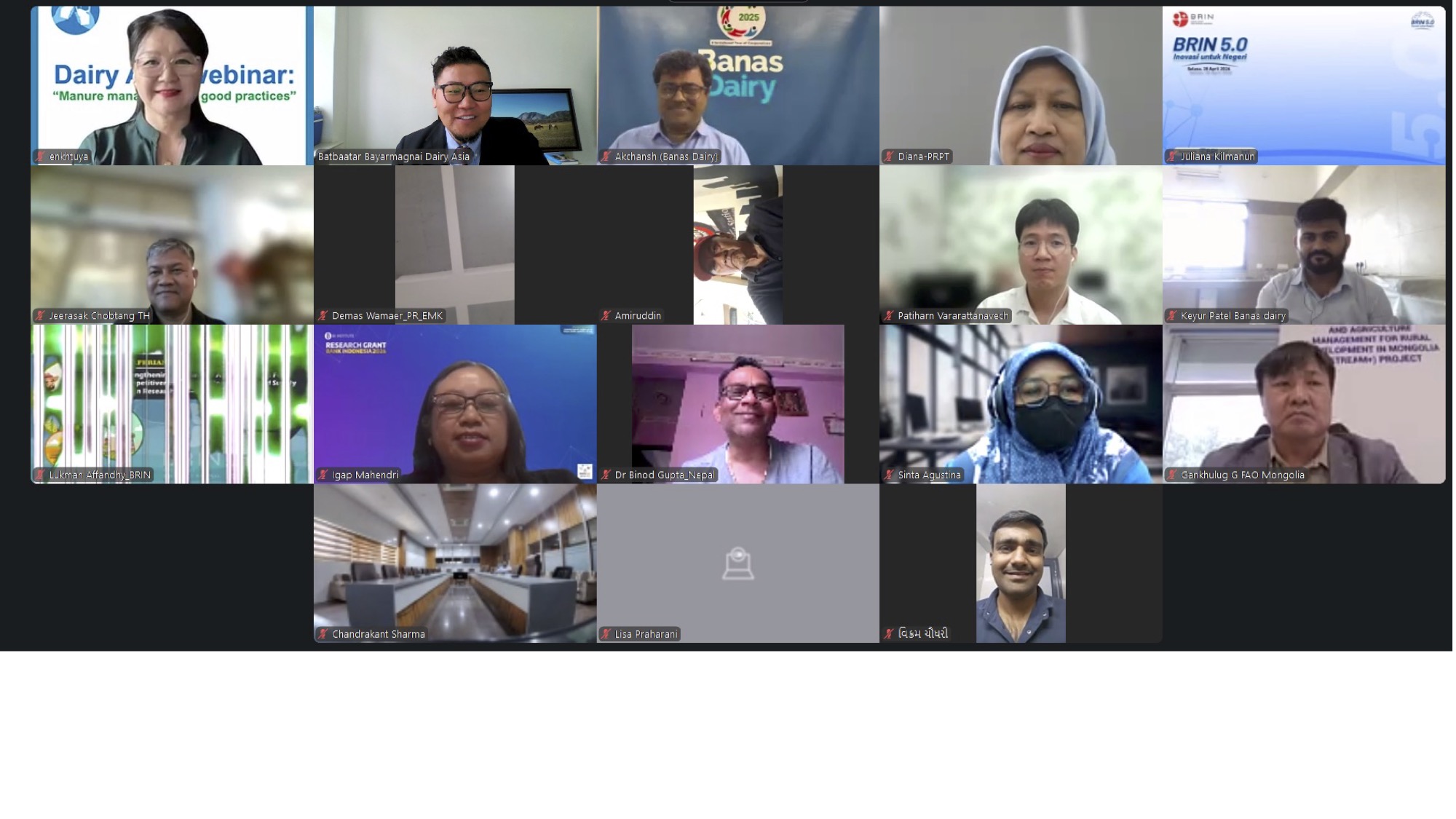
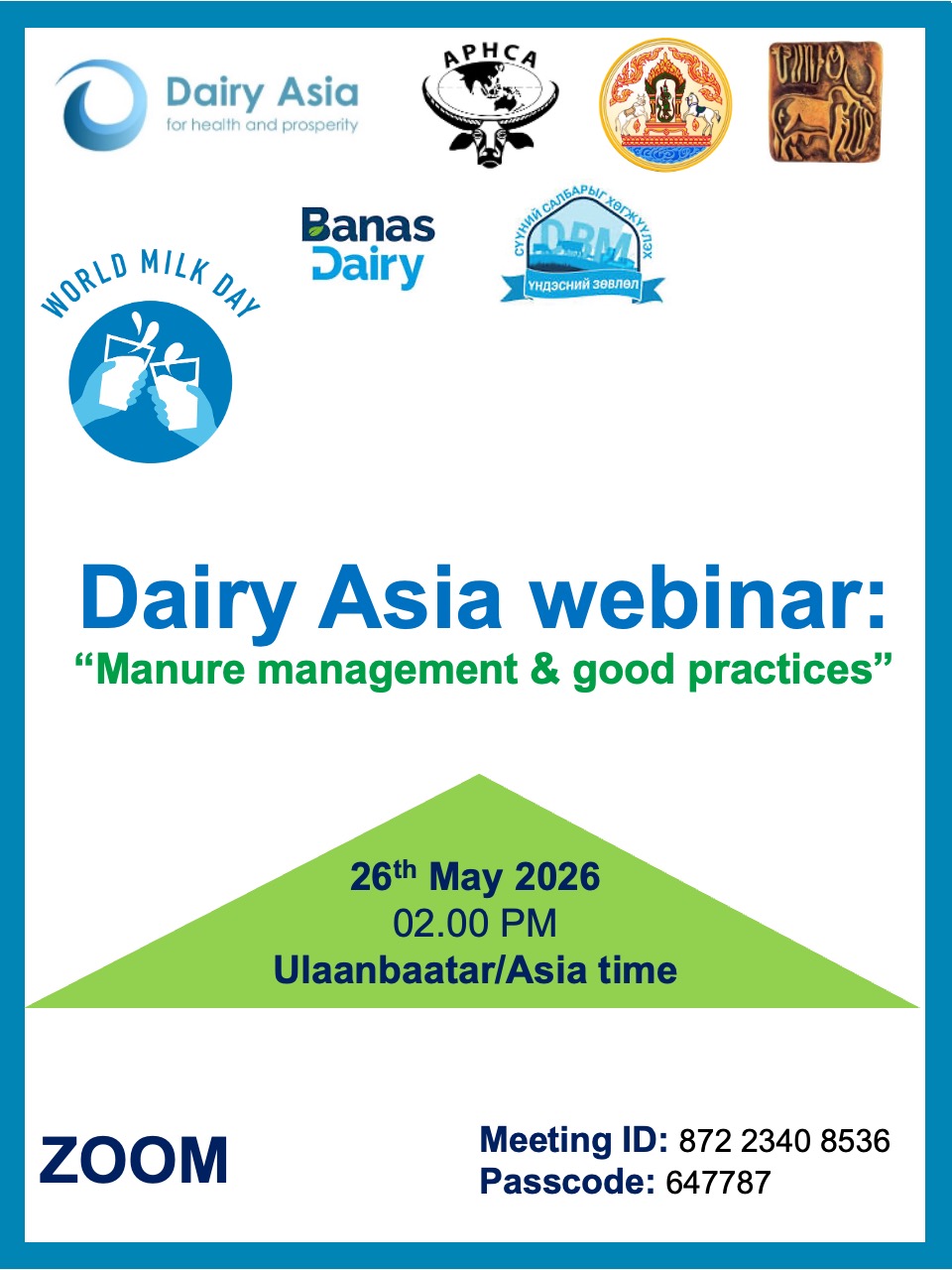
On 26 May, 2026 Dairy Asia Webinar: Manure management and good practices was jointly organized by Dairy Asia Secretariat, Department of Livestock Development, Thailand, National Dairy Development Board of India, Banas Dairy (Amul) and Mongolian Dairy Board. The event was held in celebration of Asian Milk Week initiative in support of World Milk Day.
At the webinar participated about 40 participants from India, Thailand, Mongolia, Indonesia, Nepal, UK, Philippines and Vietnam.
Moderated by Mr. B. Batbaatar, CEO & Coordinator of Dairy Asia, the webinar featured presentations on:
Dr. Patiharn Vararattanavech focuses on manure management in the country’s dairy sector. It highlights that manure management is important because Thailand had 812,234 dairy cattle in 2022, which produced 1,839 ktCO₂eq in greenhouse gas emissions. Poor manure management also causes water pollution, social complaints, and lost opportunities for energy and fertilizer recovery.
Currently, 79 percent of pig farms in Thailand use biogas systems, which achieved a reduction of approximately 3.68 ktCO₂eq in 2022. The presenter sees an opportunity to scale this success to the dairy sector. A pilot biogas project was launched in 2024 with 20 co-funded farms, where herd sizes ranged from 23 to 600 cows. However, two farms stopped operation and three were under maintenance breaks. The methane produced was mainly used for cooking.
According to a study by the Office of Agricultural Economics, the pilot farms achieved a reduction of 30.03 tCO₂eq per farm per year, which represents an 86.55 percent reduction in methane emissions compared to direct manure management. The costs of GHG reduction were found to be potentially negative, especially for larger farms.
Several challenges remain, including the fact that farm management affects gas production, long-term technical support is needed, economic feasibility varies significantly between farms, farmer awareness and engagement are important, and there is a lack of performance monitoring.
To move forward, presenter recommends identifying farm-level barriers related to technical, financial, behavioral, and support systems. It also calls for standardizing biogas and manure management systems, developing an MRV system for carbon credit generation, integrating manure practices into low-carbon dairy certification, and strengthening public–private partnerships and value chains.
Mr. Akchansh Kochar highlights the manure management and biogas initiatives of Banas Dairy, which alone contributes approximately 32% of GCMMF’s (AMUL) total turnover. The dairy works with over 3 million farmers, who collectively supply 36 million kilograms of milk (based on 3 million farmers each providing 12 kg). Banas has established three biogas plants: Dama (40 MT capacity), Bhukhala (100 MT), and Agthala (100 MT).
The biogas project covers 450 farmers across 38 villages. Procurement involves trolleys and contractors, with farmers receiving Rs 1.0 per kg of dung. The total procurement reaches 240 metric tonnes per day. The digester capacity is 29 units with a total of 17,000 m³. Raw biogas generation is 12,000 m³ per day, which produces 4,750 kg per day of purified biogas. The system also generates 58,000 kg of solid fertilizers and 182,800 liters of liquid fertilizers daily.
Regarding cattle farm conditions, farms are concrete-constructed and well managed, with each farmer owning 15–20 cattle. However, a key challenge is the presence of soil or sand in cattle feed, which leaves traces in the cow dung. Regular maintenance is performed by farmers, and contractors do not accept dung if it is not collected on a concrete surface.
According to the National Statistical Office (2025), Mongolia has 58.1 million total livestock and over 250,000 herder households. A researcher from the Mongolian University of Life Sciences (Dr. B. Nyamgerel and team) has been conducting ongoing research from 2008 to 2024 on the mechanization of intensive farms and manure waste management, with key findings including the production of manure briquettes and biochar from pyrolysis of argal (dried dung). A researcher from the Mongolian University of Science and Technology (Ass. Prof. Dr. I. Bazarragchaa) conducted a comparative international study on eco-briquette fuel standards from 2019 to 2022, sending samples of argal, horgol, and homool to Germany for testing. A pilot project led by Prof. Dr. Sonomdagva and team at the National University of Mongolia (from 2023 onward) involves a small-scale methan gas plant built by Didier Boissiere, with the gas produced used to heat a small facility.
At the business level, best practices include Tanantsar LLC, which has produced biohumus from cattle manure and earthworms since 1996; MSRT Organic Fertilizer LLC, producing biofertilizer since 2021 with a capacity of 10,000–12,000 tons per year using accelerated bio-composting; and Re Paper Studio, which has produced paper from argal since 2023 using cellulose conversion.
The main challenges facing Mongolia include an extreme cold climate (cold season lasts nearly seven months, halting composting and biogas digestion), nomadic dispersal (herders roam vast territories, making manure collection and centralized processing difficult), limited finance access (herder household debt is about 25% of GDP with no collateral for loans), knowledge and technology gaps, underdeveloped markets for organic fertilizer, a short growing season of only 95–110 days, underdeveloped supply chains for collection and sorting, quality control risks (weed seeds, pathogens, heavy metals), market barriers due to slower results compared to chemical fertilizers and weaker price competitiveness, and poor economic viability due to high upfront capital costs.
The way forward includes four strategic priorities: first, developing cold-climate composting units such as insulated, heated small-scale systems and solar-assisted digesters. Second, establishing a cooperative collection model where herder co-ops pool manure and share processing facilities per soum (sub-district). Third, providing finance and capacity building through green climate funds, training on composting ratios and biogas operation and maintenance, and aligning with NDC 3.0 targets. Fourth, developing markets and standards by creating organic fertilizer quality certification, establishing a domestic carbon credit market for soil carbon, and creating buyer linkages with crop farmers and government.

© 2026. Dairy Asia. All rights reserved. Developed by Mind Agency